 99.5% PURITY LOT VL-2887-A
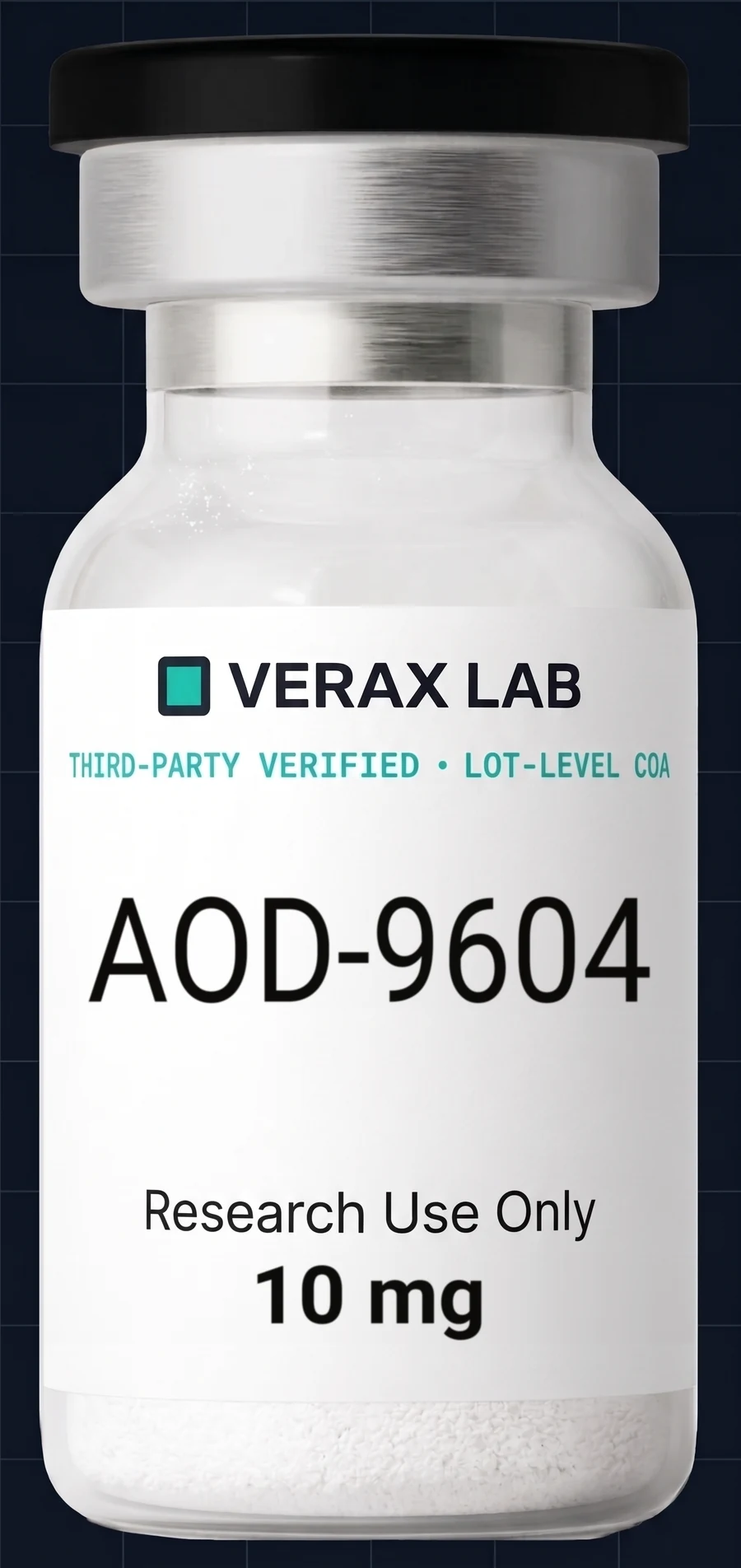
 AOD-9604
A modified C-terminal fragment of human growth hormone (hGH 176-191 with an N-terminal tyrosine) supplied as a 10 mg lyophilized vial for research into lipolysis, fat metabolism, and growth-hormone-fragment signaling.
- 1 × AOD-9604 10mg vial
- Tamper-evident flip-off cap
- Batch-tested for purity (≥99%)
- Lyophilized for stability during shipping
- Bacteriostatic water (3 mL)
About this compound
A modified C-terminal fragment of human growth hormone (hGH 176-191 with an N-terminal tyrosine) supplied as a 10 mg lyophilized vial for research into lipolysis, fat metabolism, and growth-hormone-fragment signaling.
- 10 mg lyophilized peptide per vial
- Modified hGH C-terminal fragment (176-191, Tyr)
- Synthetic peptide, ≥99% purity
- Studied for lipolytic and anti-lipogenic activity
Why the lot matters
- Synthesized and tested per lot, never as a production-run average
- Certificate of Analysis published before the lot goes on sale
- Independent lab, contractually separate from manufacturing
What "research use only" means
This product is sold exclusively for in-vitro laboratory research. It is not evaluated by any medicines agency and is not intended for human or animal administration, diagnosis, treatment, or prevention of disease.
Technical data
Current lot snapshot
Shipping
Reported use in research
AOD-9604 is investigated as a modified C-terminal fragment of human growth hormone, corresponding to residues 176-191 with a tyrosine added at the N-terminus. In preclinical models it is studied for lipolytic and anti-lipogenic activity, with research probing how the fragment may influence the mobilization and breakdown of stored lipids. A central research question is whether AOD-9604 can modulate fat metabolism independently of the growth-promoting portion of the parent hormone. Investigators use it to explore signaling pathways associated with adipose tissue and energy balance in cell and animal systems. It is frequently examined alongside other growth-hormone-derived fragments to compare metabolic activity profiles.
Reported findings
Research reports that AOD-9604 can stimulate lipolysis and reduce lipogenesis in adipose tissue preparations, effects observed in vitro and in animal research models. Published studies note that these metabolic actions were reported without the increases in IGF-1 or the changes in glucose handling typically associated with intact growth hormone. In rodent obesity models, investigators have documented reductions in body-fat measures following administration in the experimental protocols studied. Some reports also examine the fragment's stability and its interaction with lipid-metabolism pathways. These findings are confined to laboratory and preclinical research contexts and are not conclusions about any human outcome.
Handling & safety
The safety and toxicological profile of AOD-9604 has not been completely characterized. This material is supplied strictly for in-vitro and preclinical laboratory research and must be handled only by qualified personnel using appropriate protective equipment. It is not a drug, food, or cosmetic and is not for human or veterinary use. Store securely, keep away from unauthorized access, and dispose of according to applicable laboratory waste regulations.
Reconstitution
Recommended ratio
- 1 mL of bacteriostatic water per 10 mg vial
- Equivalent to 10 mg/mL (i.e. 1 mg per 10 units on a 100 U insulin syringe)
- Remove the plastic flip-off lid from the vial.
- Disinfect the rubber stoppers with alcohol wipes.
- Inject the diluent slowly down the inner wall of the vial to avoid foaming.
- Gently swirl the vial (never shake). Let it dissolve for about 10 minutes.
Storage
Unopened / before reconstitution
- Store at a stable temperature.
- Stable for 24 months.
- For long-term storage (2+ years), store at -20 °C.
Reconstituted solution
- Must be kept refrigerated.
- Avoid exposure to light and excessive heat.
3RD-PARTY LAB
| Parameter | Method | Result | Status |
|---|---|---|---|
| Identity confirmation | Mass spectrometry | Consistent with 1815.1 g/mol | PASS |
| Purity | HPLC (area %) | 99.5% | PASS |
| Net peptide content | Gravimetric | 9.96 mg | PASS |
| Appearance | Visual | White to off-white lyophilized powder | PASS |
| Residual solvents | GC headspace | Within limits | PASS |
| Microbial screening | Sterility panel | No growth detected | PASS |
3RD-PARTY LAB
| Parameter | Method | Result | Status |
|---|---|---|---|
| Identity confirmation | Mass spectrometry | Consistent with 1815.1 g/mol | PASS |
| Purity | HPLC (area %) | 99.4% | PASS |
| Net peptide content | Gravimetric | 9.97 mg | PASS |
| Appearance | Visual | White to off-white lyophilized powder | PASS |
| Residual solvents | GC headspace | Within limits | PASS |
| Microbial screening | Sterility panel | No growth detected | PASS |
| Lot | Filled | Purity | Report | Status | |
|---|---|---|---|---|---|
| VL-2887-A | Jul 2026 | 99.5% | TR-88215 | Active | |
| VL-2868-B | May 2026 | 99.4% | TR-88282 | Sold out |